This Will Leave a Mark

Burnt Hand

Do you remember the last time you burned your hand? Well, whether you realise it or not, you certainly do.


If you’ve ever burned your hand when placing it on a hot pan, the next time someone places a pan in front of you, you’re likely to think twice before even touching it. This is because your brain has created a marker which associates the pan with a burnt hand.

When terrible things happen, it’s most likely that they will leave a mark in our brains. Also, without even knowing it, they will guide our future behaviour.

This is an example of a somatic marker.

The term somatic marker originated from “soma” meaning “body” and “marker” since it marks an experience permanently in our brain.

The somatic marker hypothesis was discovered by Antonio Damasio, the head of Neurology at the University of Iowa, where he theorised about the involvement of our emotions in the decision making process.

A Somatic marker is evident when your behaviour is a result of a certain feeling or association you possess in your mind. It’s like an emotional bookmark you acquire upon witnessing surrounding events.

It happens when you link two disparate or incompatible images together.


For example, it’s like the Energizer bunny. The bunny keeps running and winning races which makes it easily remembered and associated with enduring battery power when browsing different battery brands.

Such factor plays a key role in making you pick the Energizer batteries instead of any other brand.

Energizer Bunny

Most of our somatic markers come from our past experiences. They can be based on our positive or negative experiences.

However, most businesses often resort to the negatives ones. They use fear, one of the most powerful somatic markers, to affect their consumers.

Many marketers and advertisers try to create somatic markers in the consumers’ brains to drive impulse buying or unconscious behaviour. They try to build products and ads and associate them with fear to trigger images and create desirable outcomes.

This helps them to drive automatic consumers’ behaviour which is often a byproduct of the somatic markers already present in their brains. It certainly helps them to alter the consumers’ decisions and make them choose their own brand over the others. 

There are too many products which we only purchase because of our fear. We might even purchase a product just for the sake of feeling safer and in more control of our life even when we’re not. 

What’s even more interesting is the fact that certain events might create somatic markers which later result in the creation of a specific behavioural pattern on the long run.

Think about the 2008 financial crisis or the 9/11 attacks. These certainly have resulted in significant changes in the consumer’s behaviour and affected many industries in the process.

Today, due to the nature of the COVID-19 and its ability to make people fearful all the time, it will create a powerful somatic marker which triggers certain behaviours.

Such somatic marker will affect the consumers’ perceptions and purchasing patterns in the long term.

It’s important for both of the consumers and businesses to realise that the purchasing decisions aren’t always conscious. The somatic markers are often the cause behind our behaviour which is based on our “gut feeling”.

Sometimes, our actions are seen in the form of a “fast response” when, in fact, they are only a result of the somatic markers which were made in our brain from our past experiences.


So, the next time you want to purchase something, keep in mind that you might easily fall a victim for somatic markers. After all, emotion is what most marketers thrive on.

Brand Rituals

Although most people mistake brands for merely a logo, it goes way beyond that. A brand resembles the collective and synergistic outcome of several elements including the brand’s logo, colour palette, and ritual.

Many brands tend to create rituals which entail certain habits or behaviours associated with their identity to increase their brand’s attractiveness and consumers’ loyalty.

A ritual becomes a common ground where all consumers connect and interact with the brand. It also helps to build brand familiarity which translates into trust later on.

Although it takes a lot of time to build a ritual, its effects will last for generations. Think about Oreo, for example, it’s not really a special cookie, but it has managed to create a ritual and communicate it repeatedly for its consumers. 

Wherever you go, in any part of the world, you’ll definitely meet people who know how to eat an Oreo correctly.

Oreo Cookies

Brand rituals are a very powerful tool. It helps create nostalgia, and it makes consumers engage with the brands’ offerings. This, in turn, shows that consumers care enough to take part in the ritual and thus, it certainly adds a lot of value to the brand’s offering.

Building a brand ritual could be through repetition, but the key is that it has to speak into the brand’s core elements and identity.

The reason why most brand rituals are effective lies in the fact that humans always seek belonging, whether to a brand or a tribe of some sort.

Having a ritual creates a sense of connectivity with brands and other consumers.

As it seems, humans always have a tendency to belong to a community which caters to their needs and to their self-image.  When creating a brand ritual, it invites consumers to become a member of the brand’s “tribe” or community.

To add up, upon building a community of brand enthusiasts, consumers are more likely to interact with one another which increases the brand’s perceived value. It also shifts the brand’s perception and creates more affective consumers’ responses. 

A brand-specific ritual helps to create a culture where it blends different sets of values with emotional connection and extends them with the brand’s symbols, stories, logo, and different artefacts.

This allows the brand to create a special bond and to develop meaningful engagements with their consumers.

Another importance for a brand ritual lies in encouraging consumers’ repeated purchases which transforms into a habit later on. This helps the brands to predict their consumers’ behaviour.

For example, the Oreo ritual encourages dunking the cookie in milk which generates a lot of opportunities for the brand. Oreo could offer promotions or extend their cross-selling opportunities while increasing their brand’s value in the process.

Oreo free promotion

  It’s very essential to build a brand ritual which is consistent with the brand’s identity and communicated thoroughly.

 By doing so, the brand will stand out from their competitors and become able to communicate with their consumers on a deeper level. It will certainly make a brand unique and add up to its perceived value. 


Has any brand ritual come to your mind while reading this? Share your thoughts in the comments below.

Don’t Let Your Panic Go Shopping

Panic Buying

In times of crisis, our actions rarely make sense. At certain points, it seems that our panic takes over and shapes our actions such as our purchasing decisions.

Humans tend to be at discomfort with ambiguity, and in the time of a pandemic, it’s more than normal for our actions to be misguided.

Whenever consumers feel stressed, they tend to buy their way out of it which results in panic buying – where customers tend to buy unusual huge amounts of goods in anticipation of an upcoming crisis.

Upon making a purchasing decision, fear happens to be a very strong driver. This, in turn, allows panic to take control and to become the reason behind consumers grabbing 10 extra rolls of toilet paper although they do not really need it.

Panic buying occurs for a lot of reasons. As Martin Lindstrom points out, the amygdala or “the brain’s fear centre” is activated whenever we associate fear with occurring events. Whenever consumers are exposed to negative triggers, the amygdala takes control and alters their behaviour.

With the quarantine and most countries being under lock-down, people are likely to spend more time on social media and thus, get more exposed to panic triggers. The more they read about ongoing events, the more fearful they become which results in their irrational actions later on.

Panic buying could also be due to mob mentality. The constant exposure to alarming news and to pictures of people purchasing products more than they need might lead consumers to be influenced by their peers and to adopt their behaviour on an emotional basis.

This is also an implication of availability heuristic whereby people act based on recent news they came across rather than relevant facts.

Additionally, the occurrence of turbulent events causes a shift in the consumer’s needs which could also result in panic buying. 

In moments of fear, customers will mostly care about their survival shifting their focus to the lower level of Maslow’s hierarchy of needs. Consumers will tend to care about their essentials constituting of their physiological needs such as food, water, shelter, etc.

 This could be a reason for the excessive buying of food and household products we’re currently witnessing nowadays. The more the consumers place emphasis on the notion of their survival, the larger the quantities they will order of these items.

Maslow's Hierarchy of Needs

Panic buying could lead to major problems such as chaos or supply shortages. On the other hand, it might lead to many opportunities that could be leveraged by brands.

Although the fear on COVID-19 is causing customers to behave in an anxious manner for a temporary period of time, it’ll certainly affect them on the long term and have consumers adopt new behavioural patterns and habits.

Brands should monitor their consumers precisely to detect certain patterns and adjust their offerings accordingly.

Had the customers shown a sign of impulse buying for a certain item, the business could add some features to the product to increase such opportunity and to transform this act of purchase from merely an impulse into a habit later on.

This will certainly add to the brand’s value on the long run.

On the other hand, had the customers not picked up a brand’s product even though the racks were all empty and it was the only choice left, this is certainly a point of concern that must be looked further into immediately.

Perhaps there could be a problem in the product’s packaging or worse, in the product itself.

empty shelf

The COVID-19 we’re facing today is likely to have consumers adopt new behaviours and perceptions. It will affect the way consumers interact with brands and purchase products.

Businesses should dig deep into their customers behavioural patterns to understand them better and to offer them a higher value.

Instead of reacting and panicking along with the consumers, brands need to respond and deal with this crisis in a much smarter and an efficient manner. This could be done by focusing on different concepts which are becoming of high importance to customers in their campaigns or product designs.


It is up to brands to adjust to the changes which are occurring and to predict certain trends that are likely to shape the consumer’s attitudes in the future. Perhaps while doing so, it might give them an edge over their competitors when this whole crisis is resolved.  

The Beauty Behind the Mould

Burger King "Mouldy Burger"
“Mould” is the New Black

In their new advertising campaign, Burger king (BK) broke the internet with “The Beauty of No Artificial Preservatives” in which they depicted a furry, green, and mouldy Whopper to show that they’re about to cut artificial colours, flavors, and preservatives from their signature product.  

The aim of this ad was to communicate that BK wanted to offer a healthier food option all over the countries in which they operated in and to make the customers crave healthier and organic ingredients. The whole point was to show transparency and the “real” factor behind the making of their burgers.


You can watch the ad in the video below;


On social media, the people’s opinion on this ad was divided. Some people praised BK for their daring method of communicating their message, but others did not seem to appreciate the mouldy burger as much.

Nonetheless, we have to give credit to BK that this move was pretty bold and daring.  

Although most people seemed to react negatively towards the burger’s image, it didn’t stop the social media sharing of this burger. In fact, the # for this campaign got more than 21 million impressions.

To say the least, this campaign got everybody talking about BK and their “mouldy” burger. It certainly got most marketers impressed by it.

The vivid and jarring image of this burger played a major role in grabbing everyone’s attention. It had the shocking factor which allowed it to stand out and enhanced its ability to go viral.

However, did the campaign really achieve what BK aimed for?

That just depends on BK’s goals. Had the aim of BK been to have everyone talking about its brand, then, yes it did. However, the real aim, as we mentioned above, was to emphasise on the “real” aspect of BK’s products.

BK actually managed to achieve the latter, but it might have entailed some negative consequences.

According to a social analytics company called Brandwatch, the data they’ve collected shows that nearly 50,000 people perceived the “mouldy burger” ad as disgusting. Their data also showed that about 60% of BK’s mentions during the campaign were negative. It’s also important to mention that the whole campaign received a lot of negative publicity from talk shows and different media.

Burger King's outdoor campaign for mouldy burger

Due to the controversial nature of this ad, it certainly sparked a lot of online debates. However, it must be kept in mind that the aim of this ad wasn’t to increase sales but rather to communicate the brand’s values. It aimed to show BK’s commitment to cut all artificial preservatives.

The key problem here might lie in associations. Whenever someone thinks about BK, the image shown in this latest ad is most likely to appear in their mind. This is due to the shocking value of this image which gives it an added chance of memorability.

This might also increase the likelihood of associating such image with the brand on the long run, and it might affect our purchasing decisions later on.

If we come to think about this ad rationally, we shouldn’t be surprised by the burger’s appearance after 34 days. On the contrary, we should be paranoid if it doesn’t decay.

Another problem lies in the fact that we as humans aren’t as rational as we think we are when we’re making decisions.

The truth is, when purchasing products and ordering food, especially when we’re feeling hungry, our decisions aren’t going to be rational. When doing so, it is likely that the picture of the green mouldy burger will remain stuck in our head and at the top of our minds whenever we think about BK.

To add on, the fact that most consumers viewed it as “disgusting” might affect the overall brand sentiment. It might create new unwanted links and associations with the BK’s brand.

This new ad campaign by BK certainly took the communication of “no artificial preservative” to a whole new level. By doing so, they certainly planted a concrete image of “100% non-artificial” in the consumers’ minds, but this might result in negative consequences on purchasing decisions in the future.

After all, a brand should not really want its customers to have a negative perception of it. The ultimate aim should be to decrease the negative associations and correlations with the brand and to limit them.


What’s your personal opinion on Burger King’s “Mouldy Burger” ad, was it a Hit or a Miss? Do you think it might entail some consequences for BK in the future?

Marketing in the Age of Corona

illustration provided by the Centers for Disease Control and Prevention of Coronavirus

The thing with viruses is that they catch on. They spread from one person to another and they grow exponentially. In marketing, most of us are familiar with the term “viral marketing”; marketing that allows the message to reach a huge audience quickly and cost-effectively.

This type of marketing got its name from the fact that it spreads like a virus. Many marketers want to achieve “viral marketing”, but most companies seem to overlook the marketing needed in the time of a virus spread.

Marketers should realise that with the on-going creation and spread of new viruses each year, a crisis management PR team is needed more than ever.

We all know how viruses can cause a wave of panic worldwide, this is the case with “Corona Virus” nowadays, but what’s also important is that brands take measures to protect their reputation and their customers.

So how can a virus affect a brand & its ability to offer value? And can it actually allow brands to achieve viral marketing?


In a virus outbreak, customers might create a new set of associations for a brand. The messages communicated or the actions taken by brands in that period might affect the people’s perceptions later on.

When a brand shares messages related to precautions or safety measures, it is likely to enhance the customer’s trust and the brand’s goodwill. It will imply that a brand truly cares about them and that it has given an effort to communicate with their audience on a more humane level.

This will certainly add a lot of value to the brand and develop deeper relationships with their customers. It’s not about taking advantage of the whole situation but, rather, deriving value out of it to deliver it to the customers, for in times of crisis, profit comes second.

In the light of Corona, although most brands chose to remain silent on this issue, one of the brands that broke this silence is Lush. In the UK, Lush has invited people to wash their hands in-store for free to promote the hand-washing guidelines as advised by the NHS in the UK & the WHO. This will certainly add to the brand’s goodwill & reputation later on.

Lush UK Shop

On the other hand, a virus can certainly affect a brand in the most negative way. It can lead to a substantial decrease in the sales of a brand’s products, or it might lead to an overall negative perception of a brand.

This adds importance to the fact that brands should invest more in their crises management processes to deal with such issues strategically.

Recently, one of the brands that has faced a lot of online publicity is “Corona Beer”. Although its name has nothing to do with the Corona virus, that didn’t stop customers from making certain links and associations with the brand.

Corona Extra Beer

Over the past weeks, people on different social media platforms were all sharing the results of a recent survey done by 5W PR agency which stated; “38% of beer-drinking Americans wouldn’t buy Corona under any circumstances.”

However, the sales of Corona beer show otherwise. Corona Extra has actually witnessed an increase in sales “nearly doubling the 52-week trend of the brand.” This shows that the negative online publicity has actually benefited the brand.

Although most people tend to share the results of a survey immediately, few actually bother to investigate the methodology and how it was carried out.

As reported by the PR agency, this survey was conducted by phone on 737 American beer drinkers. So, does this really represent all of the American beer drinkers?

(Plot Twist: It doesn’t)

What added to this controversy is that those 38% of beer drinkers didn’t actually describe themselves as “previous Corona-drinkers,” they only saw themselves as beer drinkers.

Also, most of the results shared on social media were to criticise those 38% of people, so it might be a win for Corona Beer after all.  Such media widespread has resulted in building more brand salience which stands for; the degree in which a brand is likely to be remembered in a purchasing situation, and thus, it increased the brand’s sales.

https://platform.twitter.com/widgets.js

The boost of Corona’s sales might also be justified by the fact that the social media publicity allowed the brand to become at the top of mind for the beer drinkers. When ordering a beer, some drinkers might not be as involved in the “choosing what beer to drink” process as others, and in these times of crisis, it’s natural for “Corona” to pop up first in their minds.


The effects of viruses on a brand could go all the way from increasing products’ sales to making people boycott your brand. It’s up to brands to choose how such dilemma is going to affect them and their customers’ perceptions.

At some point, negative publicity might be proven to be positive for your brand as in the case for Corona, but it might have been smarter for Corona to steer those online conversations and perhaps even, to make a campaign that boosts their brand salience out of it.

A “Humane” UX

User Experience across different devices
How the customer is your running start when designing a user experience

When we talk about consumer behaviour, most people tend to overlook the fact that this field extends online. Upon designing an app or even a website, it’s essential that consumers or “users” are kept in mind throughout the whole process.

The entire customer experience must be managed across all online and offline touch-points to ensure a seamless user experience. This allows for improving brand consistency and for managing brand perceptions in the consumers’ minds.

Web designers should adopt the humane aspect of user experience (UX) which allows to fully understanding the customers and their motivations to proceed with the website accordingly. By doing so, it will help to extend the brand’s essence online and to achieve synergy across various platforms.


Function vs Aesthetics

When thinking of a website design, many tend to visualise the style which often includes the images, the information placement, and the colours. However, the UX extends beyond the aesthetics of the website to its overall function and usage.

 There are several important factors that must be achieved when creating a convenient UX.  But before even sketching a website’s blueprint, designers must ensure that they have a good understanding of their customers. They should understand their customer’s interests, online behaviour, favourite type of websites or content, habits, and their action drivers.

All of these factors help to achieve an infrastructure to build the website on as well as it helps to establish a consistent brand identity & brand familiarity in the consumer’s minds. 


 The UX factors of success

After understanding the customers fully, there come the important factors which should be present throughout any website development process. These factors include; usability, accessibility, credibility, find-ability and usefulness. These factors come at play to enhance the website’s experience for all the users.

To begin with, the website must be very easy to use. Believe it or not, but people don’t really like things that makes them think a lot, so the easier a website is to use, the better. The other face of the coin of usability is accessibility. Having a website available for everyone’s usage is crucial.

After all, inclusiveness is really important and no one should be left out in the designing process.

 Another success factor for a website is credibility. A website should be legitimate so users can also trust it with their information. It is also important for the website to be found easily in the search results.

Lastly, the website should add value for the users in exchange for the time spent on the website.

By including all of these factors, it is likely to deliver a pleasant experience and to have the users spend more time on the web and even, engage with your content. 


The Worth of a Click

When designing a website, each and every small detail matters. A small change in an icon or a word could make a huge impact and achieve big results. For example, changing the colour of a cart or perhaps, changing the word cart on a website into a cart icon might increase clicks and purchases.

Have you heard of Amazon’s $300 million dollar button?  

Amazon Logo

Amazon managed to gain a $300 million worth of sales by simply changing their “Register” button to “Continue”. The reason for this button’s success is due to the fact that “Continue” carried a different set of associations. Most people perceive continue as something natural and does not require an extra effort, so they were more likely to click on it.

The key idea here is that sometimes, you actually have to test a feature to know its effectiveness.


The Meaning Behind Your Click

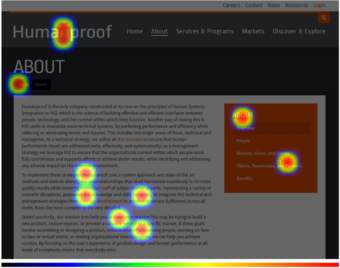
On websites, analysing clicks is really important for every click or any part that’s not being clicked gives actionable insights. Some websites have tracking tools or heat maps to detect which parts of the websites gets a lot of clicks and which parts don’t.

A heat map tool to analyse user behaviour

 By doing so, they’ll gain a deeper understanding on what to improve and on how to place different items on their website. This might actually help to deliver desirable actions from the customers and to drive better results.


 Checking Out

Every section of the website matters. It is important for the whole process of browsing or purchasing to be smooth. That being said, the checkout page must be very simple.

 Having a checkout page that demands a lot of things is likely to drive the prospects out of your website and perhaps, never on it ever again. (Remember the Amazon example?). A one-page checkout page is likely to enhance the customer’s experience and to increase the amount of sales.


CLV Boost

By delivering a convenient UX, it can certainly increase the customers’ loyalty and increase their purchases. This, in turn, will result in increasing the customers’ lifetime value (CLV).  The customers will be more likely to purchase more and thus, become of a higher worth for the company.  A convenient browsing and a checkout process might also increase the chances of impulse buying as well.


The Other View on UX

Although UX is still perceived by designers as something too technical which results in overlooking the humane aspect, it is essential to put the customers at the core of any UX design. After all, you wouldn’t want to design a perfect website for nobody to use or to benefit from. It is important to add a more “humane” perspective and approach to the process.


 Although there are plenty of additional factors which should be considered to enhance the overall UX, the ones mentioned would help give a head start.  

By offering the customers a consistent brand experience across various platforms, it might increase the chances of turning loyal customers into advocates who are willing to recommend your brand for others later on.

 At the end of the day, isn’t the ideal goal of digital platforms to transform loyalty into advocacy?

Judging a Brand by Its Cover

brand book

It is commonly said that we mustn’t “judge a book by its cover,” but is that always the case? Unconsciously, most people seem to do the exact opposite. When thinking about a brand, most of us tend to visualise similar, if not identical, characteristics, so it is crucial that brands understand the importance of adjusting every touch-point, including the store design and atmosphere, to resonate with their brand’s core identity. In fact, in marketing, there’s a phrase that reflects “atmospherics as a marketing tool”, it was coined by Philip Kotler. He uses this phrase to describe the store’s atmosphere as the “conscious planning of the environment to create certain effects in buyers” (“Kotler”). He even depicts that, sometimes, the atmosphere is the primary product upon which the customers’ purchasing decisions is based on.

Kotler states the significance of the “total product” where he suggests that consumers respond not only to the tangible aspect of the product, but rather, to the product’s augmented aspects and features. He highly emphasises the impact of the place’s atmosphere on the buyer’s purchasing decision. (You can read more about it here). Although not all brands take this into consideration, yet there are many brands which incorporate their brand elements in the store’s design.  If you’ve been to an IKEA store, you’ll certainly understand what I’m referring to.


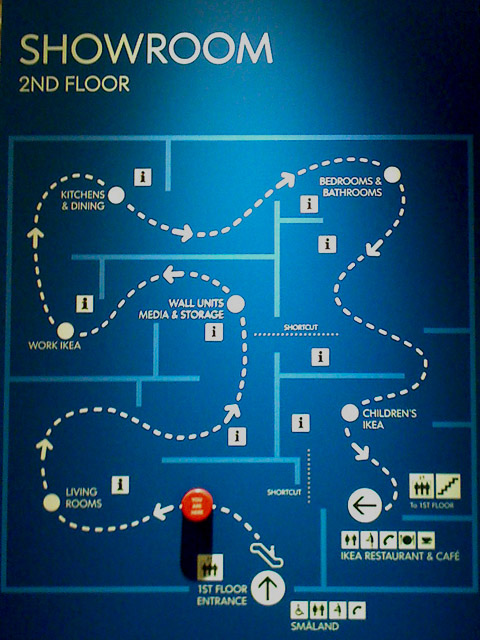
IKEA’s known for its convenient yet, visually appealing store design. Its furniture is demonstrated as if it were in its natural environment. IKEA’s stores are usually designed in a maze-like form where the products are strategically placed along the walking path. This actually allows the customers to view every item in the store unless they manage to take the shortcuts present at some points. This in-store strategy gives the customers a very pleasant experience in which they’ll later associate with the brand itself. It also encourages the customers to spend more time at the shop and to buy more items which they haven’t even thought about. On a further note, IKEA also manages to replicate its in-store style in its catalogue. IKEA’s catalogue presents the products in a similar manner as the in-store products’ placement. This extends the in-store experience and makes the whole concept of IKEA’s brand more concrete in the consumers’ minds.  

IKEA Showroom Map

Another store which succeeded in incorporating its brand elements in its store design and in building a gratifying atmosphere is Victoria’s Secret. Victoria’s Secret flagship stores could be directly noticed from miles away due to its signature and iconic look across all of the branches. Its signature black painted walls and dark lightning certainly create an inviting environment for all customers. Shopping through one of its stores certainly feels like an enjoyable experience with friendly customer service clerks who estimate appropriate sizes and carry a bag around for all your products. By having a person walk around with you whilst recommending products in a friendly manner, it is very likely to increase the number of purchases when done strategically. Also, the furnishing and dressing areas in its stores are consistent with the brand’s image as well. All of these factors resonate with the customers to create a pleasant shopping atmosphere which extends the brand’s identity.

Victoria's Secret Shop

It is extremely important that brands realise that consumers actually have a preconceived set of expectations upon walking into their store. The brand’s store experience must balance out their expectation or even exceed it. After all, that’s what quality is all about. Having an in-store atmosphere that resonates with the brand’s identity is very likely to satisfy the customers and to turn such touch-point into an opportunity to build familiarity and trust later on.  The strategic design of a store could help affect the customer’s purchasing decisions. It can increase the opportunity of impulse buying and cross/up-selling opportunities.

The atmosphere of the store must embody the brand’s message and even extend it.  When designing a store, brands could make use of several components to help communicate their identity. To start off, the brand’s colour palette should be present all through-out the store along with other visual elements such as the brightness, size, and different artefacts. Also, having salespeople whose personalities resonate with the brand’s archetype is also important. You can’t possibly imagine a non-tech savvy individual trying to sell you the newest IPhone for example.

Other factors that affect the store’s atmosphere might include the smell or even the temperature of the store. Children’s toy stores often include the smell of cotton candy or bubble gum which makes the in-store experience even more fun and pleasant. Such smells could serve as affect-creation tools which increase the brand’s associations and recall as well.

Brands must realise that their stores are an extension of their identity which tells a story about them. They must keep in mind what having a dull store means for making impact vs having a vibrant one. Customers might not remember your brand upon seeing it for the first time, but they’ll definitely remember how you made them feel at your store.

So the next time you visit a store, try to keep an eye out for the different brand’s elements present at the store for they might be affecting your purchasing decisions subconsciously.

The Mere Exposure Theory


It has been said that people tend to trust the things they’re most familiar with. When it comes to purchasing decisions or to building consumer’s loyalty, trust happens to be one of the most important drivers. It can play a huge role in making people change their perception of a brand. Although it takes a long time to build trust, it can be very rewarding on the long term.

One of the key drivers to building trust happens to be the brand’s strength. Such strength is derived from familiarity, either with the brand itself, or with its initiatives and marketing efforts. 

Humans’ reactions might vary depending on the nature of the thing they’re exposed to and its uniqueness. The more unique a thing is, the more sceptical views it’ll receive. Upon receiving a stimulus, consumers have a tendency to categorise things and to associate them with similar existing concepts in their minds. This is mostly due to decrease the mental effort exerted and increase convenience.

 Since our minds tend to favor convenience, we tend to react positively to things we already know. This is an indicator of what’s known as “The Mere Exposure Theory”, in which humans tend to like the things they’re exposed to the most.

 In marketing, it can work for visual and auditory ads, and it could affect the people subliminally and alter their responses.

This sort of justifies the fact that some brands tend to show you the same ads everywhere and to communicate the same messages all the time to increase conversion rates.  When shopping in stores, some retailers tend to put the most familiar songs in order to evoke positive emotions in the shoppers and to make them buy more and spend a longer time.

“The Mere Exposure Theory” could actually aid in establishing a sense of familiarity which would get translated into trust. It might also reach a higher level and result in building brand advocacy later on. This could be one of the reasons why some brands try not to change their logo or brand identity which allows them to stand out from the rest.

Consumers tend to be at ease with brands they trust and are accustomed to. By initiating a sense of familiarity at every touch-point, brands will be able to establish trust which would allow for building a community of brand advocates on the long term.


Story-telling for a Price


Ever since we were kids, fairy-tales seemed to be our only refuge and escape from reality.  We used to constantly read and listen to stories. To say the least, stories have played a crucial role in our lives since our childhood. Till this very day, stories still affect us tremendously, and this resulted in many companies using them across their various touch points. Marketers seem to have found the best way to exploit and to use them in their marketing efforts.

Based on several studies, stories showed the tendency to resonate with consumers the most. When listening to a story, several parts of the brain are activated. This leads the customers to visualise what they’re being told.

 This has led many advertisers to resort to story-telling in ads and when trying to talk about their products with the customers. Stories are used as an attention-grabbing method since it happens to have a high impact on the consumers. Instead of using a traditional method, advertisers resort to storytelling for consumers tend to relate to it and remember it the most.

Storytelling has also made its way in sales. Sales-people started to talk to the customers about their products in the form of a story. In sales, it’s all about solving the people’s problem and making the customers the heroes of their own stories. To demonstrate this, the salesperson might act up as a sage who offers help to the hero aka the customer in order to solve their problem.

Through stories, marketers have been able to captivate and grab the customers’ attention. They also managed to motivate them and to drive them to take actions and pay a higher premium.

Some customers are willing to pay more for a cup of coffee from Starbucks than for a regular one. However, they would not be paying for the coffee’s quality or the product’s features; but rather, they’re paying for its story. A story which Starbucks constantly communicates whether about its products, its cosy place that feels like home, or about what it should symbolise to you. Such stories of value have merely made products become an extension of our own identity.

Stories help build a special bond and relationship with the customers. They tend to resonate with them the most. By putting a high emphasis on storytelling, it certainly allows for further communication of value.

At the end of the day, are we actually paying for the actual price of the item or for its story?


The Last of Product Placement


When it comes to product placement as mentioned in the previous post, we can’t merely limit it to movies and reality shows. It happens to be present in a lot of places. Recently, video games have become a tool for brands to increase their visibility and exposure.

But, could this underused industry be the new platform for showcasing the brand’s products and making a major impact?

It has been noted that the e-Sports and video gaming market have already outpaced the music and movie industries combined. It is even expected to grow and become a billion-dollar industry, as reported by CNBC.  This also comes hand in hand with the growth of live-streaming apps like Twitch and YouTube channels that are especially made for gamers.

Such platforms should be leveraged in order to get a massive brand exposure especially when some games get millions of live-streaming viewers as the case with Fortnite and League of Legends which happen to be some of the most watched games.

Also, with gamers spending hours and months on their video games, it could be an opportunity for product placements or some marketing efforts.

However, it is important to note that such placements need to be cohesive with the brand and the video game’s story-line as well.

Recently, most of the newest video games are trying to differentiate themselves with their story-lines and narratives. Some are even relying on character building. There are also many brands like Coca-Cola that go an extra mile by creating their own game with all of their logos and symbols.  

All of these scenarios, when implemented right, could provide a new platform where marketers can increase the brand’s familiarity and recall in the minds of the consumers.

Who knows? It might even cause consumers to react subconsciously to such marketing efforts.